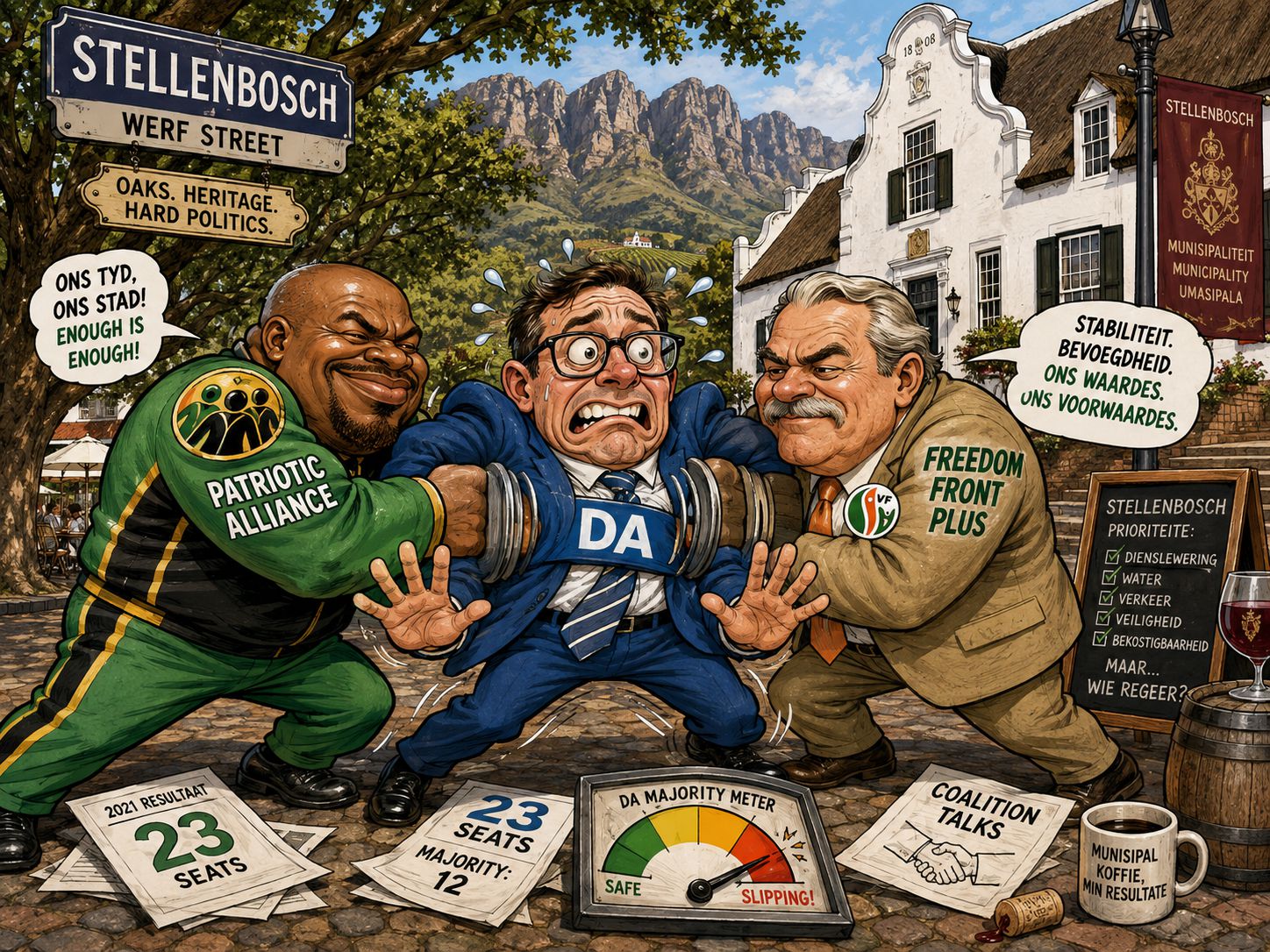
Stellenbosch has long enjoyed a reputation as a calm blue lagoon in South Africa’s otherwise choppy sea of municipal politics. While Johannesburg, Tshwane and a colorful collection of other municipalities transformed local government into late-night reality television — complete with motions of no confidence, new coalitions and politicians who suddenly rediscovered their deepest principles at 02h00 — Stellenbosch has stayed remarkably predictable.
The mathematics behind that tranquility is simple:
23.
In a council of 45 members, 23 seats give one party a majority. The Democratic Alliance won 28 in 2021. After losing Ward 16 in Cloetesville to the Patriotic Alliance this year, the tally shrunk to 27. Then two more DA councillors resigned and it was 25.
Suddenly 23 doesn’t look so far away anymore.
For the first time in years there exists a credible possibility that no single party will have a majority in Stellenbosch after the election.
And the pressure comes from two very different directions.
On the one side, the Patriotic Alliance has already proven that traditional DA support in working class communities not is not untouchable. Cloetesville was the warning shot. Similar pressure can be found in Franschhoek, Pniel, Lanquedoc, Ida’s Valley, Kylemore, Klapmuts, Jamestown and Raithby.
Residents should therefore prepare for more politicians, more posters and possibly a sudden municipal passion for infrastructure improvements that has not been around since Nokia’s glory days.
But the second threat is quieter — and possibly just as important.
On the other direction stands the Freedom Front Plus.
Here it’s not necessarily about the loudest voice on Facebook, the angriest WhatsApp group or the week’s latest political hysteria. There are signs of a quieter, deeper dissatisfaction among sections of Stellenbosch’s taxpayers, professionals, farmers and business community.
Many of these voters appreciate good administration, financial discipline and stability. That’s exactly why they traditionally supported the Democratic Alliance.
But an uncomfortable question is increasingly heard:
Who actually rules whom?
There is a perception that elected politicians are increasing to meek to take a stand against a strong, outspoken municipal administration.
Officials should administer. Politicians are elected to determine policy and political priorities.
Critics think that the relationship sometimes looks reversed: elected representatives sit back politely in their seats and nod, while somebody else decides where the car is going.
For the Freedom Front Plus, this creates an interesting opening among voters who are not looking for a political revolution.
They merely want the people who are elected as their voice to represent them.
Think about Technopark, Paradyskloof, Die Boord, Onder Papegaaiberg, Uniepark, Krigeville, Mostertsdrift, Stellenbosch Central, surrounding agricultural areas and parts of the Franschhoek Valley.
These are often voters who pay their municipal accounts, complain over dinner and the next morning simply go back to work.
They don’t necessarily march.
They don’t necessarily post political statements on Facebook .
They just move the cross .
And there the mathematics becomes interesting.
Broadly spoken an erosion of approximately 200 DA voters per ward across Stellenbosch — or the loss of just three strategically important wards, together with a weaker proportional vote — could create a dramatic change in the political balance.
This is the possible political tsunami that is hiding in small voting changes.
This doesn’t mean that 200 votes in each ward automatically costs a seat. Local government’s mixed electoral system combines direct ward seats with proportional representation.
But the point remains simple: the DA need not lose thousands of voters in each ward.
A relative small shift, in the right places, can have enormous consequences.
Twenty three seats and one party governs alone.
Twenty two seats and everyone suddenly discovers everyone else’s cell phone number.
And precisely here lies the real implication of the 23-seat threshold: it is not simply an election number, but a dividing line between two completely different forms of government.
If a single party achieves 23 or more seats, Stellenbosch’s current model of central executive control remains largely in place — fast decision-making, predictable budgets and one clear political center of responsibility.
But if the result falls even just a little under the line, the game changes overnight.
Power is no longer owned.
It must be negotiated.
A hung council means that budgets, tariffs, infrastructure projects and big policy decisions will require support from more than one political group.
The era of the automatic majority is replaced by the era of compromise.
It can be slower.
There can be deadlocks.
There can even be meetings where people have true differences.
Democracy can terribly be inconvenient.
But there is also another side.
Without an automatic political majority, municipal officials who present important policy and financial suggestions, will have to convince various political groupings of their merits rather than relying on a predictable single-party majority.
It can mean more investigation, more transparency and more political accountability.
Small parties suddenly become big players. One or two seats can mean the difference between a budget that is accepted and one that is sent back to the kitchen.
The big one question of this election is therefore not simply whether the Patriotic Alliance will win more wards, whether the Freedom Front Plus is growing, or the Democratic Alliance still remains the largest party not.
The question is whether any party in Stellenbosch will cross the 23-seat mark.
For years the question was: How big will the DA’s majority be?
This time the question could be very different: Is there going to be a majority at all?
Somewhere in Pleinstraat, somebody should be pounding the calculators very hard already.
Text: Paul Revere | Image: AI Generated